앞 강의에 썼던 방법들은 그래도 후보를 먼저 generate 해야 한다는 점이 있어서 그거를 없애려고 한다.

DB|a = a를 포함하는 transaction만 남긴 conditional database.. 그 안에서 “b”가 local frequent item이면 ab도 frequent pattern이 된다.

Benefits of the FP-tree Structure
1. Completeness (정보 손실없다)
❑ Preserve complete (i.e., lossless) information for frequent pattern mining
❑ Never break a long pattern of any transaction
2. Compactness (효율적이다)
❑ Remove irrelevant info—infrequent items are gone
❑ Items in frequency descending order: the more frequently occurring, the more likely to be shared
❑ Much reduced size, can be uploaded on memory
Ideas with FP-Growth
❑Grow frequent patterns by adding a new frequent item recursively
Given the global FP-tree and F-list,
❑ It follows divide-and-conquer: it partitions the frequent patterns into disjoint subsets (targets)
❑ For the partitioning, it uses each item of F-list. For each item, it constructs conditional pattern-base, and then construct its conditional FP-tree to find the targeted frequent items.
▪ Find a frequent item on the conditional FP-tree, construct a new FPtree conditioned by it, and grow the pattern.
▪ Recursevily repeat the process on each newly created conditional FPtree, until the resulting conditional FP-tree is empty, or it contains only a single path
▪ A single path will generate all the combinations of its sub-paths
▪ Each of the combinations is a frequent pattern
item마다 conditional pattern base와 conditional FP-tree를 만들고,이걸 재귀적으로 반복한다!

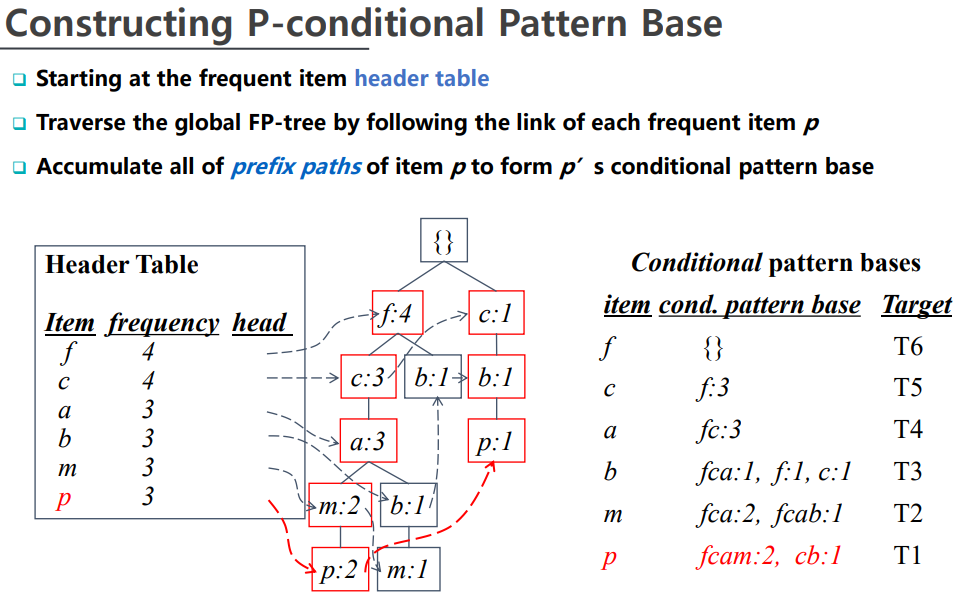
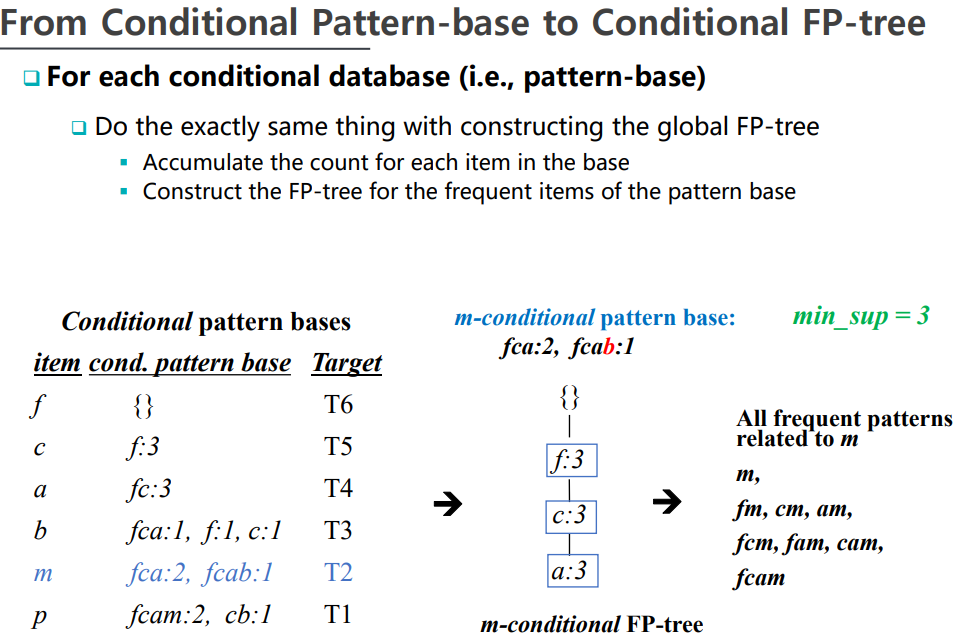


트리가 single path면:
- path의 모든 node combination β에 대해
- pattern = β ∪ α
- support = β 안 노드 support의 최소값
이게 왜 minimum이냐면 한 path 안에서 조합의 support는 그 path에서 가장 작은 count에 의해 결정되기 때문이야.
근데 single path가 아니면 아까 말했다시피 item 하나를 고르고, 그 item을 붙인 패턴 β를 만든 뒤, 그 β에 대한 조건부 트리를 만들어 다시 같은 일을 반복한다.

Why Is FP-Growth Effective?
Divide-and-conquer:
❑ Decompose both the mining task and a database according to the frequent patterns obtained so far
❑ Leads to focused search of smaller databases
전체 DB를 계속 보는 게 아니라 더 작은 DB만 보게 되므로 검색이 집중되고 효율적임
Other factors
❑ No candidate generation and no candidate test
❑ Compressed database: FP-tree structure (managed on memory)
❑ No repeated scans of the entire database: just twice
▪ 1: Counting the frequency of each item
▪ 2: Building the global FP-tree
정리하면 후보 생성이 없고, DB를 압축하고, 전체 DB를 두 번만 읽으며, divide-and-conquer로 작은 문제를 푸는 구조이다.
'학교수업 > 데이터 사이언스' 카테고리의 다른 글
| [5-2] Decision Tree + Random Forest (0) | 2026.04.01 |
|---|---|
| [5-1] MaxMiner, Closet, CHARM (0) | 2026.03.31 |
| [3-2] Improving Apriori (0) | 2026.03.16 |
| [2-2] Apriori Algorithm (0) | 2026.03.09 |
| [2-1] What is data mining (0) | 2026.03.09 |